

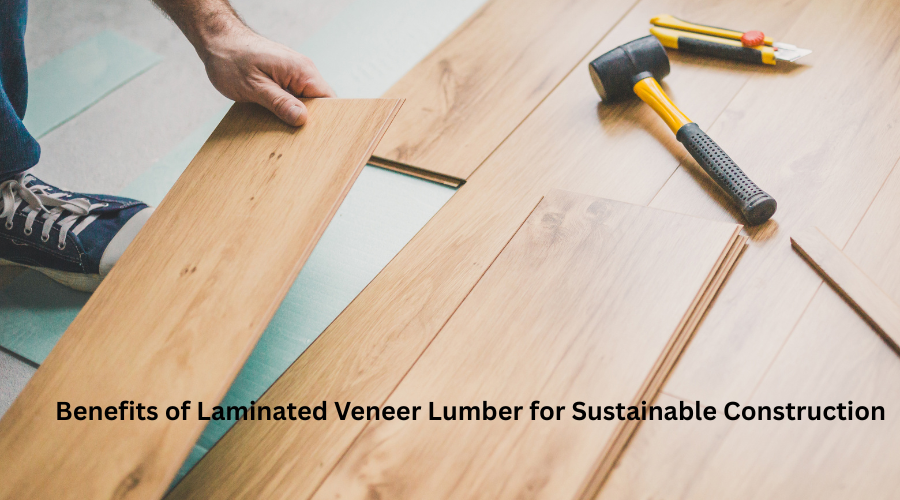
Benefits of Laminated Veneer Lumber for Sustainable Construction
The construction business is facing increasing pressure to construct smarter and greener. Common construction materials, such as traditional concrete and steel, are characterized by high carbon footprints and extremely high environmental impacts. This has forced constructors, planners, and real estate agents to seek alternatives.
LVL is a processed wood material made of thin sheets of wood veneer bonded with strong adhesives under heat and pressure. The outcome is a strong, stable, and exceptionally efficient material. It is being used in residential houses, office buildings, and major construction works across the globe. And in terms of sustainability, it is highly beneficial, as few other building materials can compete with it.
Understanding Laminated Veneer Lumber
LVL is created by peeling, drying out, and then overlaying thin layers of wood on at least some of the logs, and in the same direction. LVL is made by peeling thin wood layers from logs, drying them, and overlapping them in the same direction. The structural adhesives hold these layers together under heat and pressure, forming solid, uniform boards or beams. A high percentage of each log is utilised in the process, and this property lowers the wastage that was experienced in the hand-saw timber.
The resultant product is dimensionally stable, has high consistency, and does not possess the natural flaws, such as knots and grain irregularities, that make conventional timber weak. Such consistency guarantees the LVL to be a consistent and predictable structural material.
The reason LVL is sustainable
It is a renewable source
Wood is one such material that is really a renewable building material. Plants are replenished and planted again. In a scenario where LVL is extracted in a manner that keeps the forest well-managed, and the bodies that certify the forest are forest stewardship councils, the effects of harvesting will be minimized.
Wood in well-managed forests can be replenished, unlike concrete or steel, which require finite natural resources to be extracted. This makes LVL a truly renewable building material.
It utilizes Wood more effectively
LVL also has one of the most significant sustainability benefits, namely its efficiency in the use of raw materials. Conventional sawn timber results in significant waste. The LVL production utilizes a significantly high log percentage. The log is peeled on a rotary, yielding usable material from virtually the entire log, including trees that at other diameters would be unsuitable as fair structural sawn timber.
This efficacy implies that fewer trees have to be cut to give the same amount of structural material. It also implies that smaller tree species that grow faster can be utilized, i.e., those that can be brought to harvestable size earlier and place less long-term strain on forest resources.
Structural Strength and Performance
Better than the Traditional Timber
The structural strength of LVL is always much greater than that of traditional sawn timber. The overlaying of the construction levels the stress throughout the material, removing weak areas caused by natural defects in solid wood. This implies that LVL beams and panels can cover a longer distance with heavier loads than similar-sized timbers in traditional beams and panels.
This advantage directly becomes a sustainability benefit. Nickel-hardened material requires less of it to obtain an equal structural effect. The low amount of materials to be used per building will reduce resource use and the environmental impact of a given construction project.
Dimensional Stability
Drying of timber shrinks, warps, and twists, and reacts with fluctuations of humidity. LVL is much more dimensionally stable. Layered construction and consistent water content during manufacturing imply that LVL does not change its shape or size.
This stability has minimized waste on-site. Constructors do not have to consider any large movements or curved pieces of refuse. A stable structural design enhances building sustainability by reducing maintenance needs over its lifetime.
Lower Carbon Footprint
Carbon Storage in Wood
Carbon storage in wood-based building materials is one of the strongest environmental advantages of this type of material. As they grow, soak up carbon dioxide from the atmosphere. Once the wood is harvested and used in construction, the carbon is locked into the material until the building is used up.
LVL does not lose this advantage of carbon storage. A structure made with LVL beams and panels literally stores carbon for decades in its form. This directly opposes concrete and steel production, which release plenty of carbon dioxide into the atmosphere during manufacturing.
Lower Energy in Production
LVL does not consume as much energy as other materials, such as steel or concrete. The manufacturing process, including peeling, drying, bonding, and pressing, is somewhat energy-intensive. Still, the energy level is considerably lower than that of high-temperature processes involved in the manufacture of steel or cement.
Other LVL manufacturers also take wood residues and offcuts from the manufacturing process and use them as fuel in their kilns and drying apparatus. This will also reduce reliance on external energy transport and the manufacturing process's overall carbon footprint.
Construction versatility
Wide Range of Applications
LVL finds application in extensive structural applications. It is used effectively as beams, headers, rim boards, scaffold planks, and formwork. It is applied to the flooring system, roofing, and wall framing. Its uniform size and structural stability have made it suitable for both simple domestic construction and heavy commercial construction.
This is because it enables the same material to be sold to meet various structural requirements in a project. When a single material is used, procurement is easier, on-site complexity is reduced, and the entire construction process is simplified.
Attractive to the Modern Construction Process
LVL is compatible with prefabrication and off-site construction. In a factory environment, a component can be produced to an exact size and delivered to the installation location. This minimizes on-site waste, cuts construction timelines, and enhances construction quality.
Conclusion
Laminated Veneer Lumber is a very attractive blend of buildings and structural performance, resource viability, and environmental sustainability. LVL is a truly performance-based, environmentally friendly material for construction professionals and developers determined to build more sustainably.
FAQs
1. Is LVL stronger than regular timber?
Yes. The layered construction of LVL eliminates natural defects and distributes stress more evenly, making it consistently stronger than conventional sawn timber of the same size.
2. Can LVL be used in outdoor or exposed conditions?
Standard LVL is designed for protected indoor use. Moisture-resistant grades are available for applications where some exposure to humidity or weather is expected, but they should generally be kept dry.
3. Is LVL considered an environmentally friendly building material?
Yes. When sourced from certified sustainable forests, LVL stores carbon, uses wood efficiently, and has a lower carbon footprint in production compared to steel and concrete.