

Is I-joist stronger than 2x10?
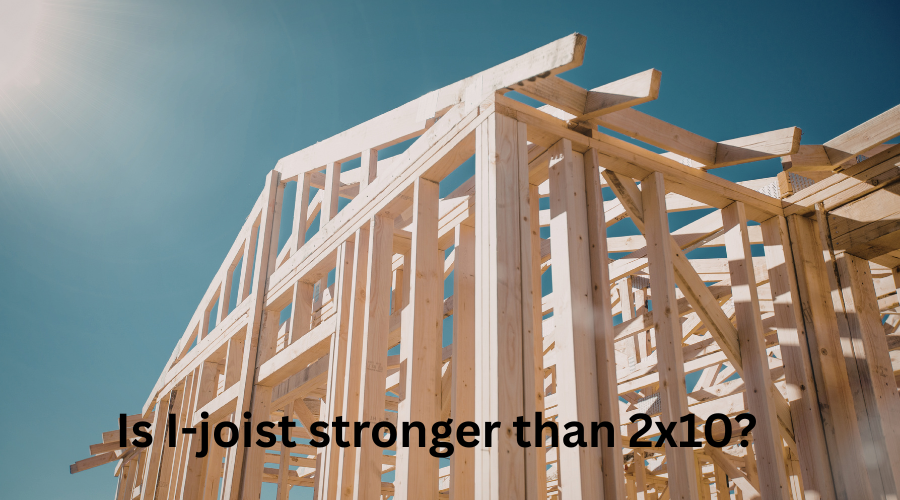
This question is among the most common in residential and light commercial construction. In framing a roof or floor, contractors and homeowners find themselves comparing I-joists to the more standard solid wood, such as 2x10. All these are popular choices. They are both applied in the same manner. However, they do not play equally in terms of strength, stability, and span capability.
The answer to that is yes, in virtually any practical use, an I-joist will be superior to a 2x10. However, it is more complicated than that. To get this, it is necessary to examine more closely how both forms of joists are constructed and the mechanism by which structural loads are transmitted.
What Is a 2x10?
A 2 x 10 is an example of solid sawn lumber. It is cut out of a log and adjusted to a theoretical dimension of 2 inches by 10 inches. As a matter of fact, its actual size is slightly smaller, perhaps 1.5 by 9.25, with drying and surfacing.
Floor and roof framing have been completed using 2x10s. It is common, readily available, and easily manipulated with the conventional carpentry tools. It works effectively when the span is shorter and the load is light. But it is limited by natural factors, which become more noticeable as spans grow longer and loads grow heavier.
What Is an I-Joist?
One engineered wood material is an I-joist. It takes the form of the letter I as it comes towards the end. Its upper and lower parts, which are referred to as flanges, are composed of laminated veneer lumber or solid timber. The central section, which is referred to as the web, is composed of oriented strand board or plywood.
The I-joists are designed so that each component can withstand a specific type of structural load. The flanges oppose the top and bottom bending forces of the joist. The shear forces are picked in the middle of the web. This structural division makes the I-joist extremely efficient in terms of size and weight.
The Measurement of Strength in Joists
To make a direct comparison between the two, it is useful to get to know how joist strength would be measured practically. They are measured chiefly by the bending strength, stiffness, and span capability.
The bending capacity is the force capacity of a joist that is capable of breaking or collapsing. Stiffness, also called modulus of elasticity, is simply the degree to which the joist deflects or bends under pressure without fracturing. The ability of a joist to span the maximum distance between supports with the load it can handle is known as span capability.
All of these three aspects are significant in the actual construction. A strong, but flexible joist will spring and be unstable to the step. A weak but stiff joist can be eliminated under a heavy point load. The most useful joists combine the three attributes.
I-Joist vs 2x10: The Direct Comparison
Span Capability
This is where the I-joist gives its strongest benefit. The range of a typical I-joist is significantly more than the range of a 2x10 of the same depth. A typical residential floor framing of 2x10 with normal spacing would be safe for movement within the range of 14 to 16 feet, depending on species, grade, and loading. An I-joist 9.5-inch depth--similar to the depth of a 2x10--can also, of course, often span 18 to 20 feet and more under the same conditions.
This disparity is a result of the constructed construction. The I-joist locates material where the bending force is greatest, in the flanges, and not, as is the case with solid lumber, making it evenly spread through the entire depth. This renders it structurally more efficient at longer distances.
Stiffness and Floor Performance
Typically, I-joists are firmer than the 2 x 10s of the same depth. This implies that I-joist floors are not as deflective under a load. Less deflection implies that there is no bouncing or springiness to the floor beneath the feet. It is also associated with reduced cracking in the finishes and in the tiling and plasterboard ceilings beneath the floor.
Solid 2x 10s may be springy on longer spans. The floor may not feel as solid as one using engineered joists, even when they are sufficient to support the necessary structural requirements. This is a noticeable difference in quality for homeowners.
Validity and Reliability
Consistency is one of the positive features of I-joists compared to 2x10s. All the I-joists of a similar kind are produced to a similar standard. The values of strength and stiffness are predictable and dependable. A 2x10 is a natural product. It has knots, grain changes, and moisture changes that influence structural performance cycles. Two 2x10s from the same batch might have different strength properties.
This uniformity makes the I-joists easier to design. They can be specified with confidence because engineers are sure that all delivered pieces will work as anticipated. When using solid lumber, variation is inevitable and must be accounted for in the design process.
Dimensional Stability
Solid lumber moves. A 2x10 may dry after installation, then shrink, distort, and cup. It is one of the leading reasons for creaking floors. The wood is loose, and the nails and screws come loose. Framing members have a gap that opens up.
I-joists are produced at a regulated moisture content. They possess a stability dimension. They do not diminish or curve as solid lumber does after installation. I-joist floors are far less noisy and more geometrically steady over time than those built with I-joists.
Weight
I-joists are very light compared to a 2x10 of similar structural capacity. This is because they can be treated on the ground. In most cases, workers can carry and position them without heavy equipment. This accelerates framing and reduces the physical demands on the construction team.
Conclusion
An I-joist is stronger, stiffer, and might do extra in most practical comparisons to a 2x10 of the same depth. The 2 x 10 remains relevant for short-span makes use of and is a common and famous opportunity among prospective contractors. However, whilst emphasizing structural overall performance, I-joists should have a clean and properly-documented benefit.