

How Do I-Joists Work?
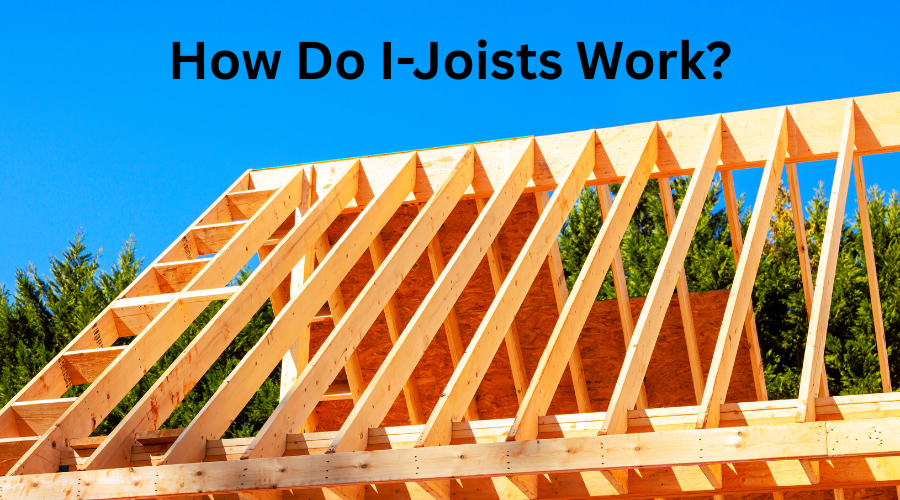
When you have ever stepped on a floor that felt solid and silent underfoot, I-joists likely made that possible. One of the most common structural components used in current floor and roof construction is the I-joist. They are constructed to be efficient in terms of carrying loads, having a long span, and being straight and stable over time.
But how exactly do they work? So what happens to the I-joist when weight is loaded on it? And what does the form concern so much? This paper makes it very clear and simple.
What an I-Joist Looks Like
An I-joist is so named because of its shape. It appears like the capital letter I when viewed from the end. It has three distinct parts.
The upper and lower horizontal ones resemble horizontal flanges. These are typically constructed from veneer lumber or laminated solid timber. These are the strongest and thickest joists. The length that joins the two flanges vertically is called the web. This is normally engineered using oriented strand board or plywood. It has a lower density than the flanges and has an equally significant structural role.
This three-part form does not consist of chance. All dimensions and material decisions are carefully designed to render the joist work as efficient as possible under load.
How Loads Work on a Joist
To understand how an I-joist functions, it is best to see what happens when a beam is loaded. A very simple beam is supported at both ends with a weight at the center. The weight of that causes the beam to bend.
When this does occur, two things happen. The lower part of the beam is strained downward, in tension. In the beam, there is very small stress in any direction at the middle, approximately midway between the top and bottom. This is what is referred to as the neutral axis.
It is the most important observation on the I-joist design. Stress is always maximum at the very top and very bottom of the beam. The middle is considerably load-free. Solid timber deposits the same material everywhere, even where it is least needed. The I-joist places heavy material where stress is greatest and lighter material in the middle where less is required.
What Each Part Does
The Flanges
The I-joist workers are the flanges. They handle the bending forces that develop when a load is placed on the joist. The upper flange is compression-resistant. The lower flange is tension resistant. Due to the nature of these forces as being most demanding, the flanges are manufactured of laminated veneer lumber, which is uniform, strong, and has no knots or grain anomalies, as solid sawn lumber does.
The broader and sturdier the flanges, the greater is the bending force that the joist can support. I-joists with a bigger distance between upper and bottom flanges, or deeper I-joists, can resist bending better as compared to shallower joists. This is why longer spans and heavier loads are specified for deeper I-joists.
The Web
The web links the two flanges together and maintains the spacing between them to the right distance. But it also has the flanges in place. The web resists shear forces. The force that attempts to move one section of the beam past another is called shear, or, in other words, an attempt to cut right through the beam. Shear forces are greatest near the supports at each end. The web can cope with these forces even without the web being as thick as the flanges or as dense.
Oriented strand board, as well as plywood, is resistant to shear. They are also lightweight, stable, and consistent, hence, the common one used as the I- joist webs.
Working Together
The actual power of the I-joist results from the flanges and web working together. Neither side works as well alone. The combination of these forms a beam much stronger than solid lumber of the same weight and depth, and is also stiffer than solid lumber. The bending stress is transferred to the flanges. The shear stress is transferred to the web. All the joist components are performing their designated tasks perfectly.
Why the Shape Is So Efficient
The I-shape is a conventional solution to a particular engineering problem. The question is this: how to make a beam that is strong and stiff yet is not needlessly heavy and costly.
Rectangular beams are very strong and have less wastage than solid beams. They place material in the middle, where it has lower structural performance. The hollow beams are cheaper, but they lack a web to resist shear forces. The classy solution is the I-shape. It retains the material on the top and bottom, where bending stress is required, and in the middle, a fine yet effective web to handle shear.
This is why we have the I-shape, besides timber engineering, also in structural steel design. The same applies to steel I-beams. The form is effective because it corresponds to the material distributions in the beam and their associated stress distributions. Every engineering engine is among the most effective structural cross-sections.
Practical Opportunities through the Internet
Among the most feasible characteristics of I-joists, the ability to use services online is included. Pre-cut knockouts: Round or square holes are cut into the web when manufacturing. Mostly, these openings do not require any further cutting or drilling of pipes, electrical cables, or ductwork.
Using solid timber joists, all the holes will have to be cut in place. The location and size of any hole should always be controlled to avoid weakening the joist. For I-joists, the manufacturer has already identified the safe locations for openings.
Conclusion
I-joists operate by placing powerful material in the locations where structural forces are required. Knowledge of I-joist function will help explain why it has become the preferred option in current floor and roof framing.
FAQs
1. Can the web of an I-joist be cut on site?
Small openings can be cut in the web according to the manufacturer's guidelines. The flanges must never be cut or notched. Always check the manufacturer's specifications before making any modifications.
2. Why are I-joist flanges made from laminated veneer lumber?
Laminated veneer lumber is consistent, strong, and free from natural defects like knots. This makes it ideal for flanges, where the highest bending stress occurs and reliability is critical.
3. Do I-joists make floors quieter than solid timber?
Yes. I-joists are dimensionally stable and do not shrink or warp after installation. This reduces the movement that causes squeaking in floors built with solid sawn timber.