

How to Choose the Best I Joist Manufacturer
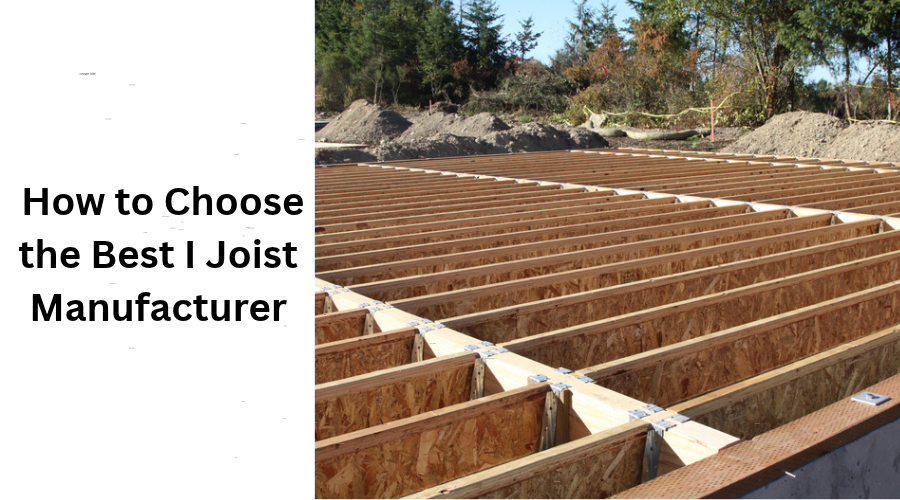
I joists may be why the floor feels so flat and level when you stand in a half-framed house. The engineered wood members have quietly invaded residential and light commercial buildings. Manufacturers play a bigger role than buyers realize. If there is no deal with the bad batch, there may be squeaky floors, delays on site, or worst of all, structural issues that can be costly to resolve.
From the builder and contractor to the architect and homeowner managing their own project, this guide explains what I joists are and why the manufacturer's choice matters, along with the key points to consider before ordering.
What Is an I Joist?
An I joist is an engineered structural member in the shape of the letter “I.” It is formed from two horizontal flanges, often of laminated veneer lumber (LVL) or solid sawn lumber, joined to a vertical web, which is typically made of OSB or plywood. The shape is clever. While the flanges take most of the bending stresses, the thin web provides shear resistance and separation of flanges. This makes the member strong and light, and it uses less wood than a solid timber member with the same capacity. I-joists are used mainly for floor joists and roof rafters, and sometimes for wall framing in specialty applications.
Why I Joists Are So Popular
Understanding the benefits will help you see what a good manufacturer provides.
Dimensional stability. When dry, solid lumber twists, shrinks, and warps. I-joists are produced at uniform moisture content, which eliminates floor squeaks and cracks in finishes.
Long spans. They can offer a larger span than conventional lumber, allowing plans that eliminate a combination of support walls or beams.
Lighter weight. These allow easier handling by the crew, thus enabling quicker installation.
Service openings. Numerous I-joist models feature pre-cut web knockouts for plumbing, wiring, and ductwork, but with no opening cut in the joists.
Efficient use of resources. They make effective use of small trees and small-diameter wood, which may otherwise be discarded.
Why the Manufacturer Matters
On paper, many I joists look alike. In reality, there are different qualities. Performance is affected by the strength of the adhesive used to bond the web to the flange, grade of lumber, precision of cutting, and moisture control. You can't see joists, so issues often don't show up until after installation-when they're behind ceilings and subfloors, too late, and costs are highest.
1. Check Code Compliance and Certification
This is the first filter, and it's a must! I joists should be produced in the United States and Canada to recognized standards, such as ASTM D5055, and the products should include an evaluation report from ICC-ES (an ESR report) or the Canadian Construction Materials Center. Request and read the latest evaluation report. It will identify permitted dimensions, permissible loads, hole-cutting guidelines, and installation guidelines. Consider also third-party quality auditing (APA or similar quality inspection agencies) that generally test production samples on a regular basis.
2. Look at the Materials Used
Not all flanges and webs are equal. Flanges are usually stronger and more consistent than solid sawn lumber, but finger-jointed or machine-graded sawn lumber can be used. Inquire about the lumber grading and testing process. Both OSB and plywood can be used for webs. The important thing is that the panels are rated for structural use and exposure appropriate. Inquire about the adhesive, too. It should be a long-lasting, waterproof structural adhesive, as one of the worst defects imaginable is a failed glue line.
3. Critically analyze the Product Range
A quality supplier will provide a number of different flange widths, load magnitudes, and depths for your choice to match the product to the job and not work around what is allowed. Common depths range from approximately 9.5 inches to 16 inches and higher, depending on the flange size/load. Also ask about related products. Because manufacturers produce the same types of hangers and connectors for rim board and LVL beams, it also simplifies the system assembly. Mixing parts of different manufacturers may create engineering challenges.
4. Review Engineering and Design Support
Successful manufacturers don't merely deliver a product. They guide you in the right use. Look for:
Span tables and load charts that are clear and up to date
Free or low-cost layout and design software
Access to an engineer to answer questions or evaluate tricky designs
In-depth installation instructions: bracing, hole placement, bearing requirements
This support can save hours of field rework and prevent mistakes. A design problem that arises on an actual construction project is worth many times the difference in the unit cost if the technical team is responsive.
5. Inquire About Quality Control
You want to know how a manufacturer ensures that each shipment is of good quality. Good answers include:
Regular strength testing of finished joists
Lumber and finished product moisture monitoring.
Automated cutting and assembly with tight tolerances.
Batch tracking to trace any problem back to its source
Ask about their defect and return process too. Knowing how a company handles its mistakes says a lot about its character.
6. Take Reputation and track record into consideration
Structural products have such a thing as experience. Check the manufacturer's experience in the field and how they've applied their products. Request references from builders and/or contractors whose work is comparable to what you need; then call them. Patterns can also be uncovered from online reviews, industry forums, and local lumber merchants. Dealers experience the difference between those that call and those that don't. They tend to say what they really think, as their reputation relies on it!
7. Think About Supply Reliability
The best product is worthless if it is late! Build schedules are extremely demanding, and a late joist package could slow down the entire crew. Inquire about the lead times, production capacity, and distribution. Are there selected warehouses or dealer networks in their area? What are their methods for dealing with seasonal demand increases? Can they deliver on a set date and keep to it? On a large development project, determine if they can provide the full volume without loss of quality or delay.
8. Compare Pricing Sensibly
While price is important, consider it one of several. If the quote is very low, it could be an indicator that the materials used are more affordable, the bond is less strong, or technical support is limited.
When comparing quotes, take the time to consider the big picture:
The cost per linear foot of a material
Delivery charges
Allowances for waste & cutting
The cost of accessories and connectors
Design support and warranty
9. Examine the Warranty
Confident manufacturers stand behind their product. Carefully read the warranty. Find out the duration of coverage, the inclusion criteria, and conditions. Many warranties are invalid if the machine was not installed properly or if it has been left to stand long enough on-site to become wet. Check for a clear and reasonable warranty.
10. Check Sustainability Credentials
Demand from clients and regulators has led to an increasing attention to environmental effects
of building materials. Manufacturers that are sourcing from certified forests (FSC, SFI, or PEFC) and publish environmental product statements (EPDs) make it easier to achieve green building goals like LEED. While it may not be a top priority for you, proper operation and material usage often go hand in hand with sustainability.
Red Flags to Watch For
If you ever encounter one of these:
No evaluation report or code approval
No willingness to reveal test information or offer technical help
Variations in size or obvious defects in test specimens
There is a rush to purchase or a price reduction.
No local support or dealer network
Failure to communicate during the quoting period, which often worsens after the sale.
Conclusion
Choosing an I joist manufacturer isn’t just a purchasing decision. It's a choice about a building's framework. With the reputable supplier, you can expect reliable products, helpful technical support, and peace of mind for the floors and roofs above.
FAQs
1- What is the best place to buy I joists in bulk for a retail store?
Buy from manufacturers who will take bulk orders. Large orders usually mean better prices and consistent product quality.
2- How to buy I joists at wholesale prices affordably?
Compare quotes from different manufacturers and ask about their wholesale price ranges.
3- Is there any joist manufacturer that provides low pricing with customization in bulk quantities?
Yes, some manufacturers offer bulk pricing and customization services. Direct communication with the suppliers about each project is necessary.
4- What is the timeframe of an order for I-joists in bulk shipment?
Production time depends on production schedules and order size; generally, it's a few days to several weeks for large orders.
Leave Your Comments
Recent Post