

LVL vs sawn timber: what’s the difference?
The structural timber market is changing fast. Builders, contractors, and project managers who were specifying the same materials five years ago are now finding that those choices are being scrutinized more closely by clients, by engineers, and by project budgets that simply have less room for error. If you are still choosing one material simply because you are accustomed to working with it, then you might be choosing a worse material without meaning to and that would reflect badly on your project. What you need is a clear understanding of the difference between the two materials to make the right choice for your building project.
This blog breaks down the real differences between LVL (Laminated Veneer Lumber) and natural grain timber, so you can make smarter specification decisions on your next project.
What Is Sawn Timber?
Sawn timber is exactly what it sounds like. It is wood cut directly from logs at a sawmill, shaped into standard structural sections, and used across a different construction applications. It is one of the oldest building materials in the world, and for good reason. It is accessible, cost-effective, and widely understood across the supply chain.
What makes natural grain timber unique is its organic character. The grain runs the full length of the board, giving it a familiar aesthetic and workability that many builders still prefer for residential framing, floor joists, rafters, and formwork.
But that organic character comes with a price. Natural timber has defects such as knots, splits and warping due to moisture, all of which are part of the picture. And this is where timber grading comes into play.
Timber grading is the process of classifying sawn timber according to its structural integrity and physical characteristics. Grades such as MGP10, MGP12, and MGP15 tell specifiers how much load a piece of timber can reliably carry. The problem is that even within a single grade, there is natural variation. Two pieces of MGP10 timber from the same batch can perform differently under load. For projects where consistency is non-negotiable, that variability is a genuine risk.
What Is LVL (Laminated Veneer Lumber)?
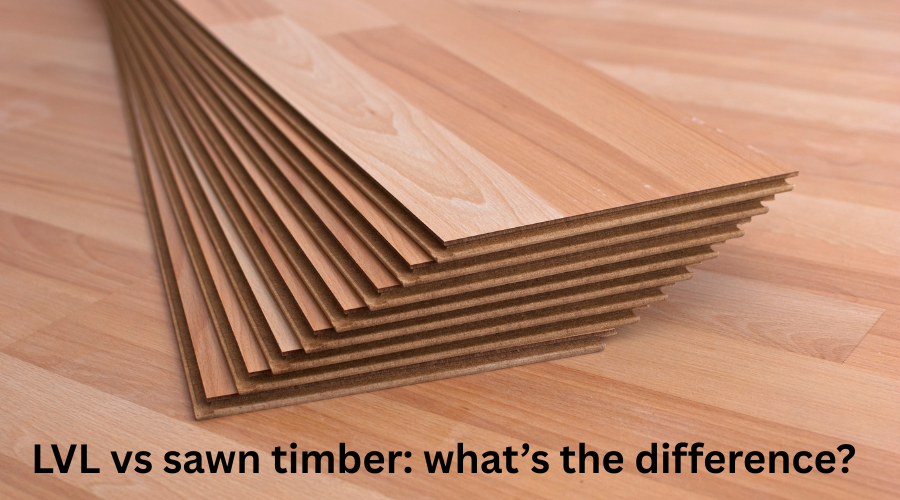
LVL (Laminated Veneer Lumber) is a composite wood material manufactured by bonding multiple thin wood veneers together using structural adhesive, with all grain running parallel. The result is a dense, dimensionally stable beam or panel that behaves with a level of predictability that sawn timber simply cannot match.
Unlike natural grain timber, LVL is produced under tightly controlled factory conditions. Every board is manufactured to a precise specification. Defects that would weaken sawn timber like knots, grain deviation, and moisture pockets, are either eliminated or distributed so evenly across the laminations that their structural impact becomes negligible.
As one of the most widely adopted engineered wood products in modern construction, LVL is now a standard specification in commercial buildings and residential projects. It is really versatile material specifically where longer spans, higher loads, or tight tolerances are preferred.
LVL vs. Sawn Timber: A Deeper Look at Their Characteristics
Let us get into the sHere is how both materials stack up across the criteria that matter most to construction businesses.
Strength and Consistency
LVL wins here. Because it is manufactured rather than grown, its structural properties are uniform from one end to the other and from one batch to the next. Sawn timber, regardless of its timber grading, carries inherent variability. For structural engineers signing off on a design, that consistency in LVL reduces liability. For contractors on site, it reduces waste from rejected pieces.
Span and Load Capacity
LVL can be manufactured in much longer lengths and larger dimensions than what a single log can practically yield. This makes it the go-to choice for long-span beams, ridge beams, and heavily loaded headers. Sawn timber is typically limited in both span and load capacity by its natural dimensions and grade.
Dimensional Stability
Sawn timber moves. It shrinks as it dries, it can twist, and it can bow over time if not properly stored or installed. LVL is significantly more stable. Its cross-laminated veneer construction resists the moisture-related movement that causes so many issues and hassles on site like squeaky floors, cracked plasterboard, doors that no longer close properly.
Timber Grading vs. LVL Quality Control
Timber grading for sawn timber is a classification system applied after the fact -- the tree has already grown, and you are working with what nature provided. LVL quality control happens at the manufacturing stage. You are building the structural properties into the product from the start. That is a fundamentally different level of control.
Cost of LVL vs. Timber
This is where many procurement decisions stall. The cost of LVL vs. timber is not straightforward. On a per-linear-metre basis, LVL is more expensive than sawn timber. There is no getting around that. But total project cost tells a different story. LVL's consistency means less waste on site. Its dimensional stability means fewer callbacks and defect rectifications. Its longer spans can reduce the need for intermediate supports, which saves on labour and materials elsewhere. When you factor all of that in, the cost of LVL vs. timber gap narrows considerably -- and in many commercial applications, LVL actually comes out ahead on total cost.
Sustainability
Both materials can be considered eco-friendly in this aspect. Sawn timber from responsibly managed forests carries low embodied carbon and is fully biodegradable, and that counts as a positive. LVL, as one of the newer generation of engineered wood products, uses wood fiber more efficiently and can be sourced from fast-growing plantation species. Neither is a clear winner here. If you have to make a choice then that solely depends on your project's environmental regulations and your supply chain's certification credentials.
|
Material Type |
Natural grain timber |
Engineered wood product |
|
Strength Consistency |
Variable by grade and batch |
Uniform across every piece |
|
Timber Grading |
MGP grading applied post-production |
Quality controlled at manufacturing stage |
|
Span Capability |
Limited by natural log dimensions |
Long spans achievable by design |
|
Dimensional Stability |
Prone to warping, shrinkage, and twist |
Highly stable, moisture resistant |
|
Load Capacity |
Good for standard residential loads |
Superior for heavy and complex loads |
|
Cost of LVL vs. Timber |
Lower upfront material cost |
Higher unit cost, lower total project cost |
|
Aesthetic Appeal |
Natural character, ideal for exposed applications |
Uniform appearance, less suited for feature use |
|
Sustainability |
Low embodied carbon from certified forests |
Efficient fibre use from plantation species |
|
Best Suited For |
Residential framing, budget-sensitive projects |
Commercial builds, long spans, tight tolerances |
When to Choose Sawn Timber
Sawn timber remains the right call in several scenarios. Residential framing on standard span projects where MGP-graded timber meets the structural requirement is a perfectly sensible choice. Budget-constrained projects where the additional cost of LVL cannot be justified by the structural demands also favour sawn timber. Similarly, where natural aesthetics matter -- exposed rafters, feature beams, or timber cladding -- natural grain timber delivers a character that no engineered product can replicate.
It still performs. Just know its limitations before you specify it.
When to Choose LVL
If your project involves long spans, heavy point loads, multi-storey construction, or tight construction tolerances, LVL should be your first call and not your fallback option. Commercial fitouts, apartment buildings, and large-format residential builds are all environments where LVL's consistency and load performance directly reduce construction risk.
Your competitors in the commercial construction space are already making this shift. Specifying LVL (Laminated Veneer Lumber) on the right projects is no longer a premium option reserved for high-end builds. It is increasingly the baseline expectation on any project where structural performance and programme certainty matter.
What Industry Trends Tell You About Timber & LVL
The adoption of engineered wood products in commercial and multi-residential construction has accelerated significantly over the past decade. Building codes in Australia, the UK, and across Europe have progressively updated to accommodate taller and more complex timber structures. Mass timber and LVL are at the center of that shift.
Sustainability regulations and reporting requirements are becoming stricter with each passing year. Clients and developers are asking harder questions about the co-friendly nature of both materials. Such questions concern embodied carbon, material certification, and supply chain transparency. Both sawn timber and LVL can satisfy these requirements -- but only if your supply chain is properly documented and your specification choices are defensible.
The businesses that are getting ahead of this are not waiting for clients to ask. They are building material knowledge into their estimation, procurement, and design processes now.
Conclusion
The LVL vs. sawn timber decision is not a matter of one being universally better than the other. It is a matter of matching the right material to the right project conditions. Natural grain timber still has a strong role in construction. But if you are specifying it by habit rather than by analysis, you are taking on risk you do not need to.
Understand your timber grading requirements. Model the true cost of LVL vs. timber across the full project scope. And recognise that engineered wood products like LVL (Laminated Veneer Lumber) are no longer a specialist choice -- they are a mainstream structural solution that your procurement and specification process should already have a framework for.