

Why I-Joists Are Stronger Than Traditional Wood Joists
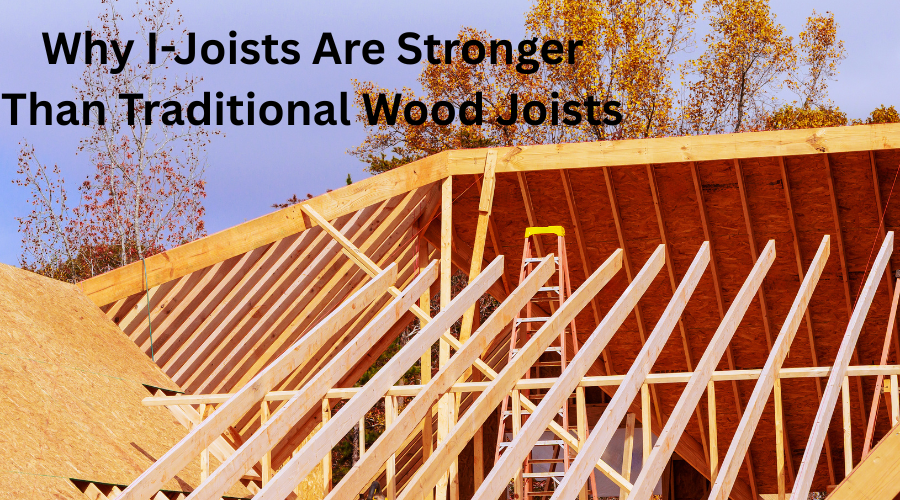
The type of joist to use is very important when constructing a floor or roof structure. Joists are horizontal beams supporting floor and ceiling loads. They push loads and pass them to the walls and beams underneath. The type of joist affects building stability and longevity.
Solid-wood joists have long been the standard. They worked well enough. Some restrictions came with them. Nowadays, I-joists are a common and widely believed substitute. They have been designed to suit all measurable aspects. Knowledge of why I-joists perform better than traditional wood joists helps builders and homeowners to make wiser decisions.
What Is an I-Joist?
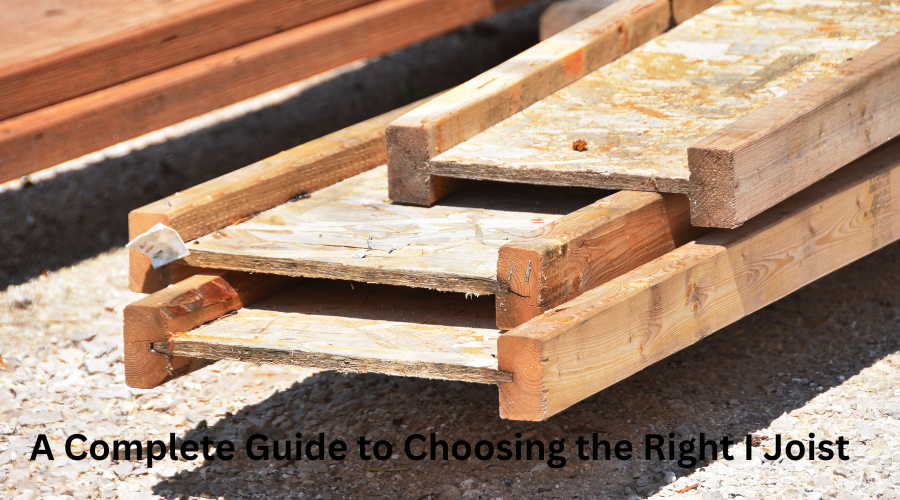
An I-joist refers to a wood product. It is named after its shape; it resembles the letter I when seen at the end. It has three main parts. The upper and lower parts are called flanges. They are commonly made of laminated veneer lumber or plain timber. The central section is called the web. This is normally composed of oriented strand board or plywood.
Every section has a certain purpose. The flanges handle the compression and tension forces in the joist when the joist deflects under tension. The web opposes shear forces and maintains the flanges separated to the right distance. These components combine to form a backbone that, at its weight, is very powerful.
What Is a Traditional Wood Joist?
A conventional wood joist is just a solid sawn timber. It is cut directly from a log and used as a structural member.
Building construction with solid wood joists is long-standing and old-fashioned. They are easy to deal with and easy to find. But wood is a natural product. It has knots, grain irregularities, and moisture variations. Such natural features create weak points that affect structural performance.
Why I-Joists Are Stronger
Engineered for Consistency
The greatest manufacturing benefit of I-joists lies in their construction. Their production is under controlled conditions. All parts are chosen and assembled to meet the requirements. There are no knots. No grain irregularities. No weak points are unpredictable.
Traditional wood joists are cut from natural timber. There is no such thing as the same pieces. A single joist could be absolutely clear and solid. Another from the same lot may have a large knot in the center. The strength of the joist is decreased by that knot. The problem of variability is completely removed with I-joists.
The I-Shape Works with Physics
The I-shape is an aesthetic feature, but it's not only that. It is an engineering ideology. The joist bends slightly when a load is suspended on it. The uppermost layer is compressed. The lower surface is distended. The points of maximum stress are at the top and bottom of the joist. The central part has significantly less stress.
Solid wood joists distribute material evenly throughout the depth. It implies that a large amount of wood is in the center, and it does not add much structural strength. The I-joist places the material at the top and bottom where required, with a lower weight in between. It is a more effective use of material, resulting in higher structural performance per unit weight.
Greater Span Capability
I-joists can cover longer distances compared to the traditional wood joists of the same depth. This is a high practical benefit. An increase in spans reduces the number of intermediate supports. This opens up floor plans. It minimizes the count of load-carrying walls. It allows greater freedom in designs by architects and builders.
A solid joist of the same depth made of wood would offer greater resistance to the same load at the same distance. The I-joist is engineered and therefore can resist deflection more. This implies that floors become firmer to step on.
Dimensional Stability
No Warping or Twisting
Movement is one of the most annoying issues with solid wood joists. Timber shrinks, warps, twists, or cups upon drying up after being installed. Such a motion makes the floors squeak. It can develop uneven surfaces. It will even crack finishes applied on top.
I-joists are produced at a regulated moisture level. The wood parts are stable and engineered. They do not warp them or bend them as solid timber does. After being installed, they do not move. I-joist flooring is less noisy and more reliable in the long run.
Consistent Dimensions
All the I-joists with the same specification are produced in the same size. This simplifies the installation process. Even nominally the same wood joists may differ slightly in actual size. These minor differences may cause installation issues, which are time-consuming to fix.
Lightweight but Strong
The I-joist is much lighter than the solid wood joists with a similar structural strength. This eases their management in the field. In most cases, workers can carry and place them without the use of heavy machines. This accelerates construction and reduces labor costs.
On-Site Benefits in Action
Pre-Cut Openings
Most I-joists are fitted with pre-cut web knockouts. These are openings that make it easy to run forests of pipes, cables, and ductwork through the depth of the joists. This is one of the greatest practical advantages. In solid-wood joists, any opening must be drilled on site or cut. This takes time. It must also be done carefully to avoid weakening the joist.
Available in Long Lengths
I-joists come in far longer lengths compared to the solid wood joists. Solid timber can only be as long as the tree it is formed from. I-joists are made to the required length. It implies that the number of joints required decreases over distance. The reduced number of joints will result in fewer potential weak points and a cleaner installation overall.
Conclusion
I-joists are superior to the traditional wood jointers based on evident and clearly understood reasons. For those building or renovating where floor and roof performance matter, I-joists are a smarter, more reliable choice than solid wood joists.
FAQs
1. Can I-joists be used in both floor and roof construction?
Yes. I-joists are suitable for both floor and roof applications. They are frequently used in residential and commercial construction for both purposes.
2. Are I-joists more expensive than traditional wood joists?
The upfront cost of I-joists is generally higher. But the savings in labor, fewer supports needed, and better long-term performance often make them more cost-effective overall.
3. Can I-joists be cut or modified on-site?
The web can be cut carefully to create openings for services. However, the flanges must never be cut or notched. Any modifications should follow the manufacturer's guidelines strictly.
4. Do I-joists perform well in wet or humid conditions?
I-joists perform best when kept dry. Prolonged exposure to moisture can affect the adhesives and engineered wood components. Proper protection during construction and in service is important.